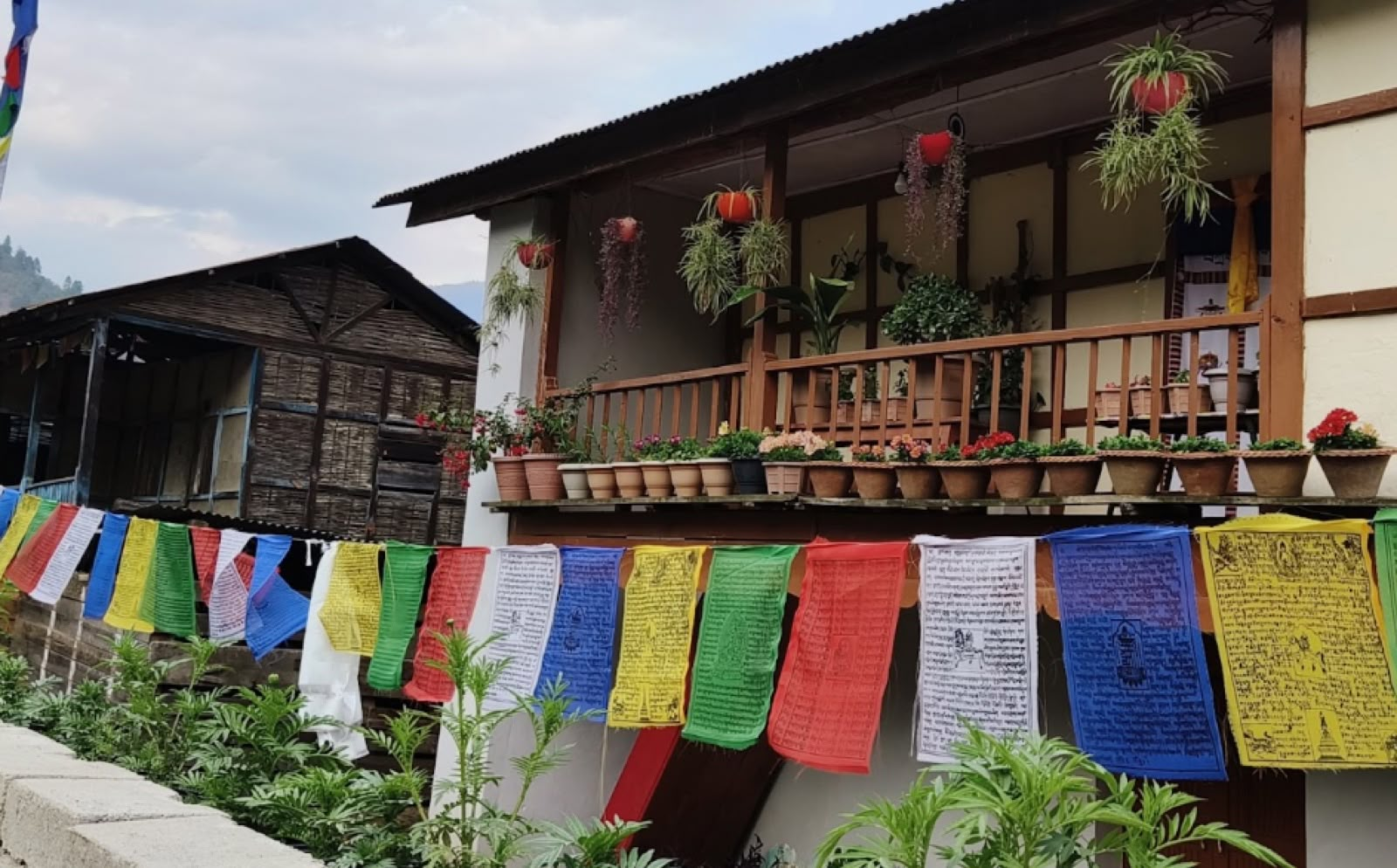
As a road climbs through the Himalayas, the landscape seems to keep changing its scale. A bend reveals a valley, a monastery appears on a distant ridge, and then, almost unnoticed at first, a line of small flags begins to move in the wind. Blue, white, red, green and yellow flicker against snow, rock, forest and sky.
They are easy to mistake for decoration. They are not. In the Himalayan Buddhist world, prayer flags are part of a living religious landscape. Their printed mantras, auspicious symbols and images are placed where the wind can carry their blessing outward. They can be seen in Tibet, Nepal, Bhutan, Sikkim, Ladakh and Arunachal Pradesh, although local styles, rituals and religious lineages differ.
The most common horizontal prayer flags are known in Tibetan as lungta, or “wind horse.” A set usually contains five colours in the sequence blue, white, red, green and yellow. Together, they represent the five elements and the wish that life may remain in balance. 1 2

What the five colours represent
The colours are best understood as a set, not as five isolated symbols. Their central meaning comes from the elemental world: sky or space, air or wind, fire, water and earth. These associations are also close to the experience of Himalayan life, where weather, altitude, rivers, forests and mountains shape every journey.
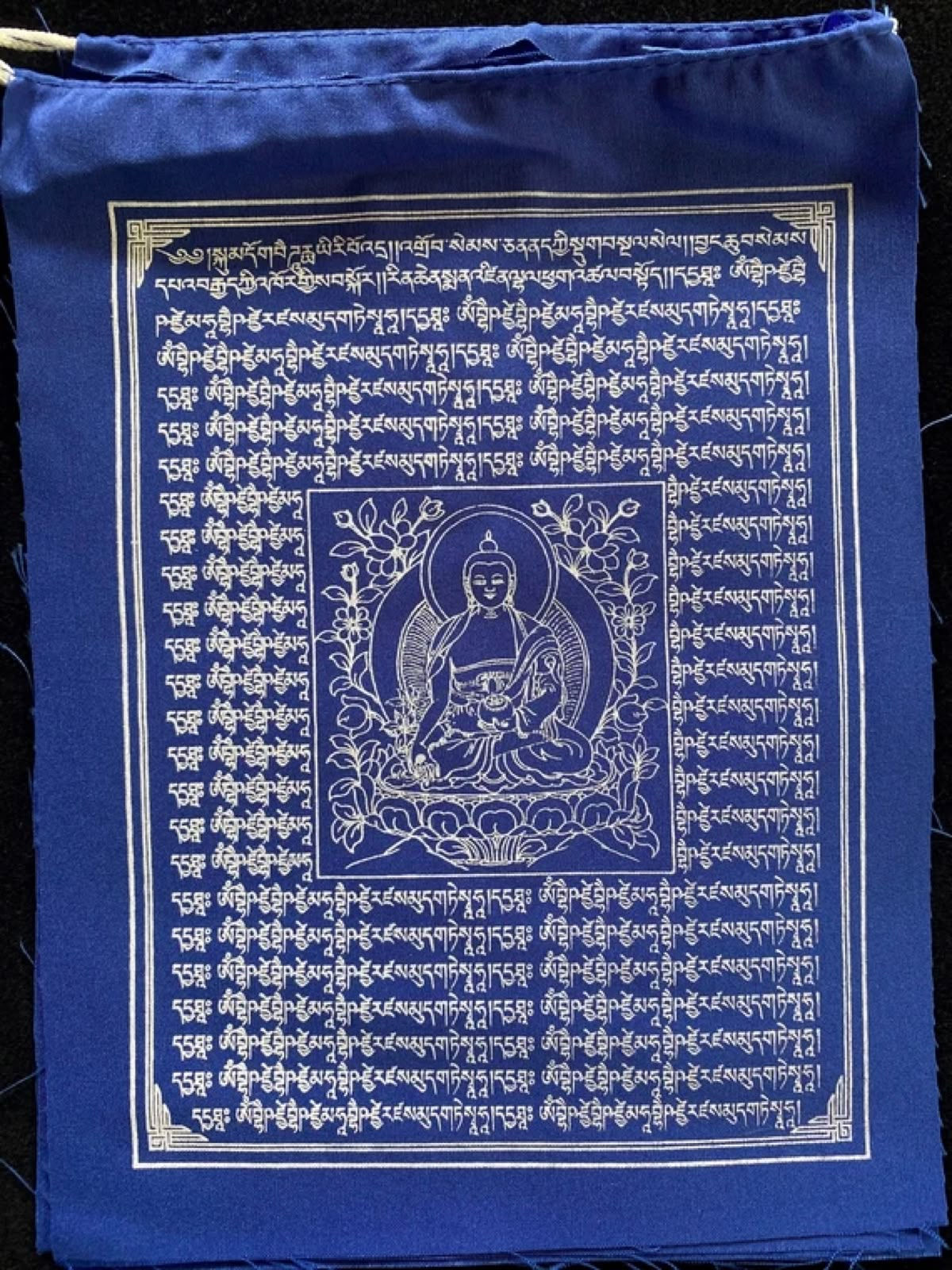
Blue: sky and space
Blue represents the sky and space. It is traditionally placed first in the sequence, as if opening the field in which all the other elements exist. Against a mountain horizon, the blue flag can seem to merge with the sky itself.
Space is not emptiness in the ordinary sense. It is the vastness that allows clouds to gather, winds to move and light to travel. In the spiritual imagination of the flags, blue suggests an open field rather than a closed boundary. It reminds us that the prayers are not intended for one person alone. They are released into the larger world.
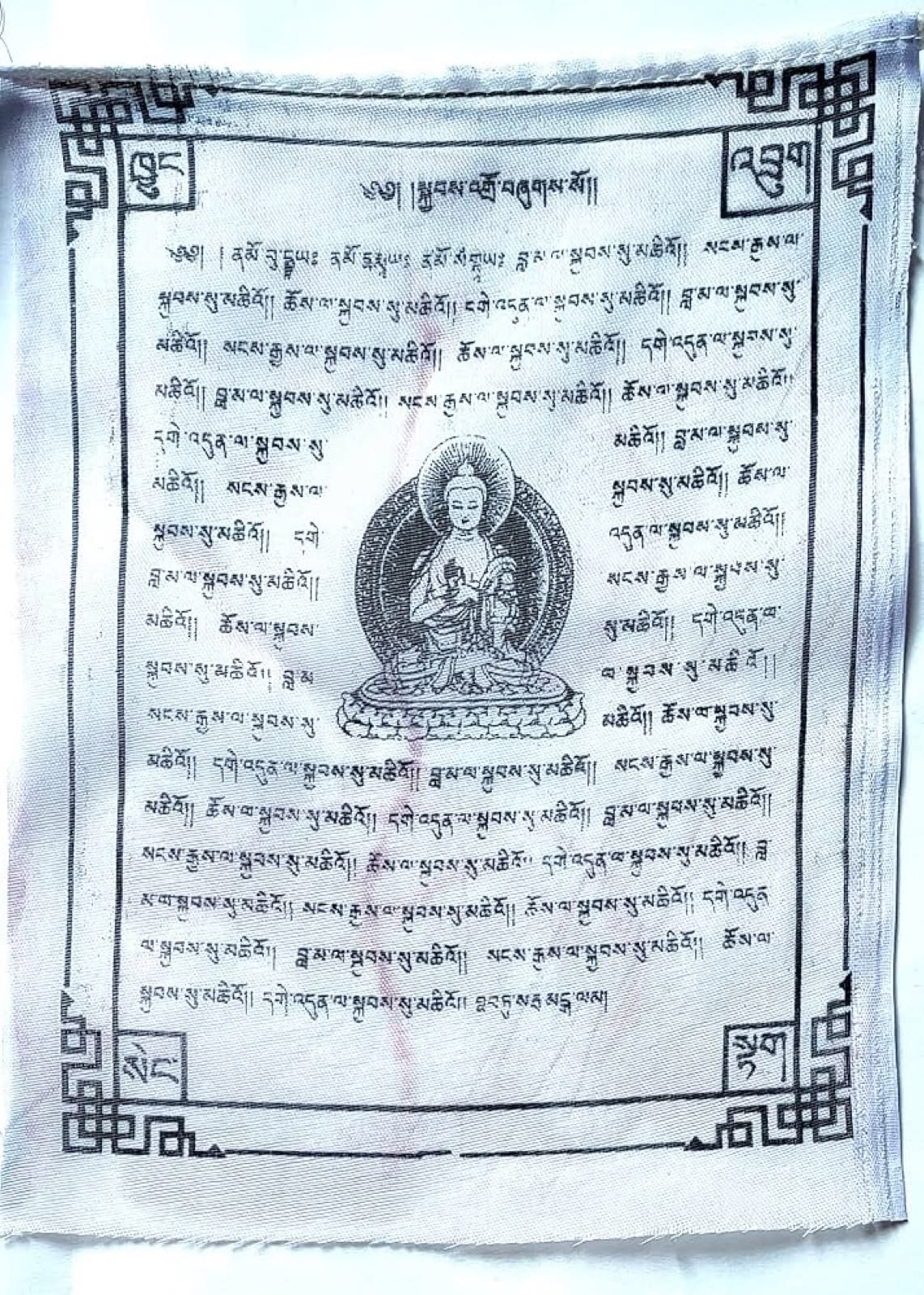
White: air and wind
White represents air and wind. It is the element that gives the flags their visible movement and carries their words beyond the cloth on which they are printed.
This is why a prayer flag is not simply a written prayer displayed on a wall. Its traditional setting is often a high place: a mountain pass, a monastery roof, a bridge, a stupa or a sacred landscape. The wind becomes part of the act of transmission. Tibetan Buddhist sources describe the mantras and images on the flags as being carried by the wind for the benefit of living beings. 1 2

Red: fire
Red represents fire. It evokes warmth, light and energy, but also transformation. Fire changes what it touches. It cooks food, gives heat in severe weather and turns darkness into visibility.
The red flags are especially striking when they are seen against snow or dark rock. Their colour is not merely dramatic. Within the five-colour arrangement, red is one part of a larger balance. It does not stand alone as a symbol of power; it belongs beside the quieter openness of blue, the movement of white, the fluidity of green and the steadiness of yellow.
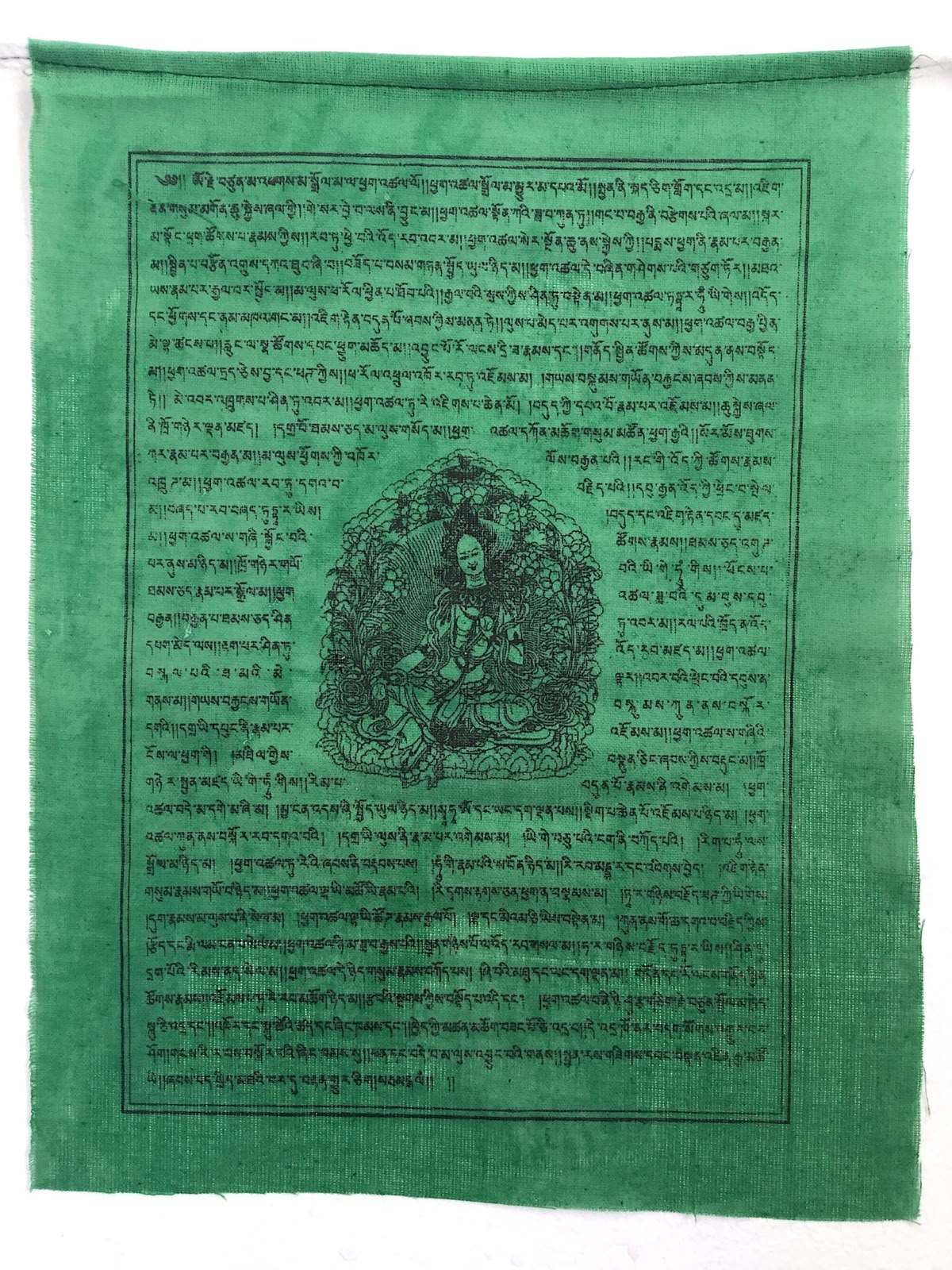
Green: water
Green represents water. In a Himalayan landscape, water is never an abstract idea. It appears as glacial melt, fast rivers, monsoon rain, springs and hidden streams beneath forested slopes.
Green brings the idea of flow. It suggests movement that can adapt to the shape of the land, while also sustaining life. In the complete set, it helps express the interdependence of the elements: water feeds the earth, wind moves across it, fire transforms it, and space holds the whole cycle.
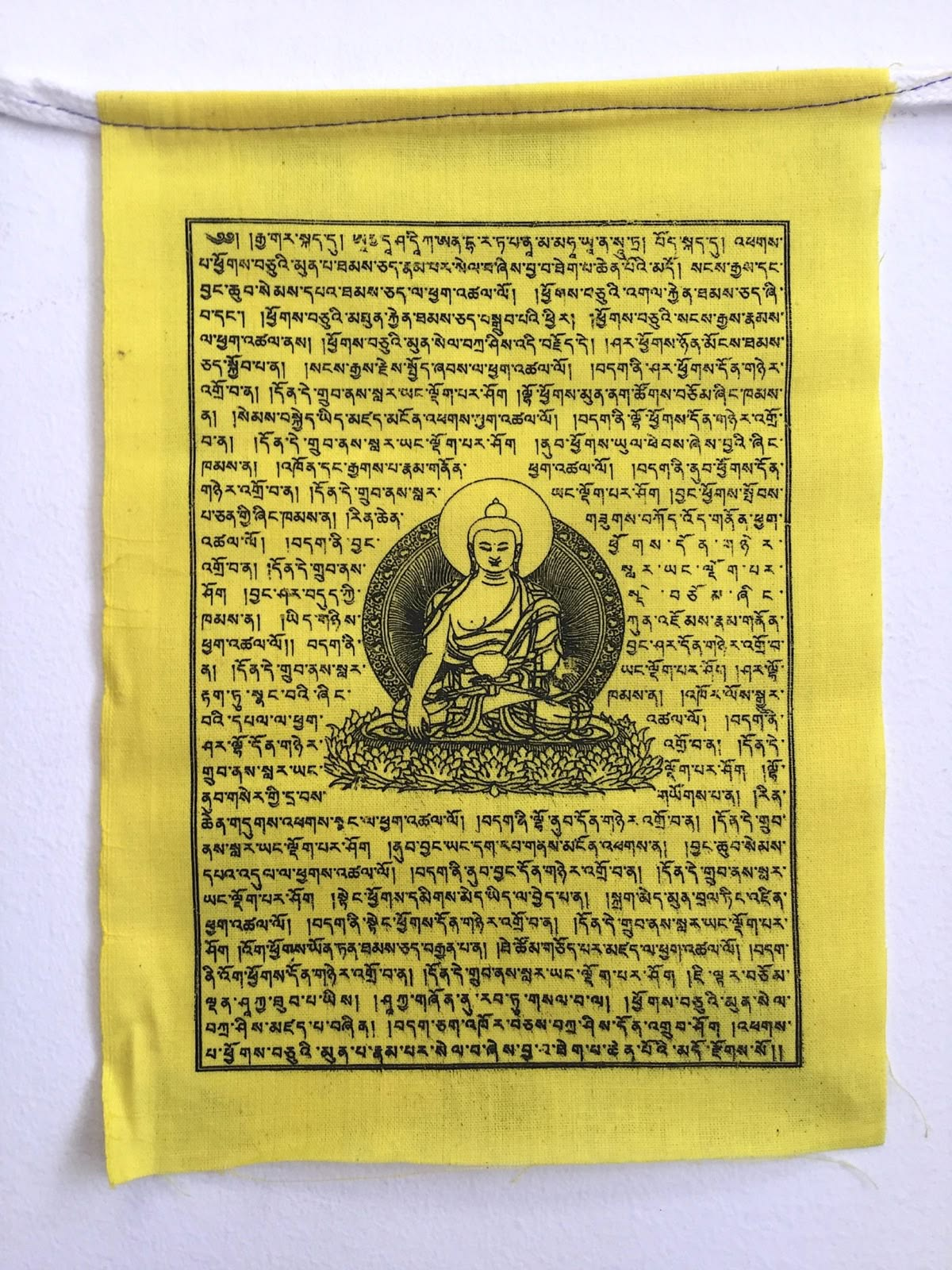
Yellow: earth
Yellow represents earth. It is the grounding colour in the set: the soil beneath a village, the mountain that holds a monastery and the ground on which travellers stop before continuing over a pass.
Placed at the end of the familiar sequence, yellow gives the cycle a sense of arrival. The prayers may be carried into the open air, but they remain connected to the physical world and to the communities who live in it.
It is useful to remember that these elemental meanings are more reliable than popular lists that assign a different personality trait or promise to every colour. The flags do not function as a simple colour chart. Their meaning comes from the relationship among the five elements and from the compassionate intention with which they are made, blessed and raised.

The wind horse and the prayer on the cloth
The best-known prayer flags carry a wind horse, or lungta, at the centre. The horse bears the Three Jewels of Buddhism: the Buddha, the Dharma or teachings, and the Sangha or community of practitioners. Around it are mantras, sacred syllables and auspicious designs. The corners commonly show four powerful animals known as the Four Dignities: the dragon, garuda, tiger and snow lion. 1
Not all prayer flags are identical. Some are square or rectangular flags strung along a line. Others are large vertical banners called darchog, attached to poles. They may be found at monasteries, mountain passes, sacred sites, village entrances and high ridges. Their height is practical as well as symbolic: the wind can reach them, and the printed prayers can be placed in open contact with the landscape. 1 2
The flags are also a reminder of impermanence. Traditional cotton flags fade, fray and eventually disappear. Their weathering is not necessarily treated as failure. It can be understood as part of their purpose: a prayer is offered, carried into the world and allowed to change with time. 1

How Buddhism travelled into the Eastern Himalayas
The Buddhist history of the Himalayas is not a single straight line. Teachings, teachers, texts, pilgrims, traders and ruling families moved through a network of highland routes. Religious influence also met older local traditions and changed as communities made it their own.

From India into Tibet
According to historical accounts, Buddhism entered Tibet in more than one major phase. It first received royal support in the seventh century under Songtsen Gampo, with connections to Buddhist centres in Nepal and China. Under the later king Tri Songdetsen, Buddhism became a state religion. The eighth-century master Padmasambhava, known in Tibet and Bhutan as Guru Rinpoche, is associated with the establishment of tantric Buddhism in Tibet. After a period of political and religious disruption, a “second dissemination” began from about the middle of the tenth century. Vajrayana Buddhism then took deep root in Tibet, along with the institutions, texts and lineages that would later influence much of the Himalayas. 3
This Tibetan development is important for understanding the flags. The custom of raising prayer flags may have older roots in Tibetan cultural areas, while the mantras and Buddhist imagery printed on them belong to a religious world in which wind, sound, landscape and merit are closely connected. The Rubin Museum notes that the practice of raising flags may predate Buddhism in some Tibetan cultural areas, even as the flags later became thoroughly integrated into Buddhist ritual life. 2

From Tibet into Bhutan
Bhutan developed its own Buddhist identity through several lineages. Bhutanese religious tradition gives Guru Rinpoche a central place and preserves many sacred sites associated with his journeys, meditation and teachings. His legacy is especially strong in the Nyingma tradition, the oldest of the major schools of Tibetan Buddhism.
Over time, the Drukpa Kagyu tradition became particularly influential in Bhutan. It is a Tibetan Buddhist lineage with roots in Tibet and has played a major role in Bhutanese religious and political life since the early seventeenth century. The Nyingma and Drukpa Kagyu traditions therefore both matter when discussing Bhutanese Buddhism; Bhutan should not be reduced to a single uniform school. 9 10

From Tibet and Bhutan into western Arunachal Pradesh
The region around Tawang and West Kameng is traditionally known as Monyul, or the land of Mon. The Monpa communities of Tawang, Kalaktang and Dirang share traditions that connect them with Tibet and Bhutan. The local historical account is careful to note that migration did not happen in one single wave. People moved through the region over centuries, and the exact dates of every movement cannot be established with certainty. 6
Buddhism entered this borderland through the same broad network. The Tawang regional account describes an early Buddhist presence associated with the seventh century and says that teachings may have begun filtering into Monyul from Tibet during that period. It also preserves the important local tradition that Guru Padmasambhava visited the region during the eighth century. Places such as Taktsang are remembered as sites connected with his meditation and blessing. These accounts combine history, oral tradition and sacred geography, and should be respected as such rather than forced into one simple chronology. 5
Before the spread of Buddhism, local religious life included traditions referred to as Bon, with rituals connected to deities, spirits and specialist priests. Buddhism did not erase every earlier belief. In Monpa religious life, a number of older deities and protective beings were incorporated into a Buddhist universe and worshipped through Buddhist ritual forms. This blending is one reason the religious landscape of western Arunachal Pradesh feels both distinctly Tibetan Buddhist and deeply local. 5 6

The establishment of Tawang Monastery, or Gaden Namgyal Lhatse, in 1680–81 gave the region a powerful institutional centre. It was founded by Merak Lama Lodre Gyatso in accordance with the wishes of the Fifth Dalai Lama. Today it remains a major spiritual and cultural institution for the people of the region. 7 8
The Monpa are broadly associated with Tibetan Mahayana Buddhism. In Tawang, the majority follow the Gelugpa tradition, while Nyingmapa practice also has a presence. Their religious life includes household chapels, offerings, the recitation of mantras, prayer wheels, circumambulation of sacred sites and community ceremonies. 5 6
Seen in this context, the flags beside a Tawang road are more than a distant reminder of Tibet. They belong to a borderland culture that has absorbed influences from Tibet and Bhutan while preserving local histories, landscapes and ritual practices.

A small note about the Dalai Lama’s Buddhism
The Dalai Lama is a major figure in Tibetan Buddhism, but it is more precise to say that the Fourteenth Dalai Lama belongs specifically to the Gelug, or Gelukpa, school. Gelug is one of the four principal schools of Tibetan Buddhism, alongside Nyingma, Sakya and Kagyu. Tibetan Buddhism itself is a form of Mahayana Buddhism that includes Vajrayana methods, tantric practices and the lama-based transmission of teachings. 3
The Dalai Lama is not the head of every Buddhist tradition in the Himalayas. His religious lineage is Gelug, although his public teaching and moral influence extend far beyond that one school. In the Tibetan tradition, Dalai Lamas are also associated with Avalokiteshvara, the bodhisattva of compassion. 3

This connection is particularly meaningful in the Tawang region. The Sixth Dalai Lama, Tsangyang Gyatso, was born in the Mon Tawang area in 1683, only a few years after Tawang Monastery was established. His birthplace near Urgelling remains an important part of the region’s religious memory. 4 5
For travellers, this history offers a more accurate way to understand what they are seeing. A line of flags in western Arunachal Pradesh reflects Tibetan Buddhist traditions, but it also reflects the movement of people and ideas across Tibet, Bhutan and Monyul, as well as the continuing presence of Monpa culture.
Reading the flags on the mountain road
The next time the colours appear on a distant ridge, it is worth reading them slowly. Blue opens into sky and space. White moves with the wind. Red carries the energy of fire. Green recalls water. Yellow rests on the earth.
Together, they express balance rather than a private wish. The cloth carries words, but the wind carries them onward. The colours weather, the ink fades and the flags are replaced. Their endurance lies partly in that cycle of renewal.
They also ask a traveller to look beyond the photograph. Behind the five colours is a long history of Buddhist transmission, local adaptation and mountain communities living with a difficult and magnificent landscape. In Tawang and western Arunachal Pradesh, that history can be felt not only inside monasteries, but also in the flags moving above the road.
References
[1] Tibetan Nuns Project, 5 Things to Know About Tibetan Prayer Flags
[2] Rubin Museum of Art, Prayer Wheel: Accumulating Merit Every Day
[3] Encyclopaedia Britannica, Dalai Lama
[4] The Office of His Holiness the Dalai Lama, Short Biographies of the Previous Dalai Lamas
[5] Tawang Tourism, Advent of Buddhism in the Region
[6] Tawang Tourism, History of the Land and People
[7] Tawang Tourism, Tawang Monastery
[8] Ministry of Tourism, Government of India, Tawang Monastery
[9] Encyclopaedia Britannica, Drukpa Kagyu
[10] BhutanWiki, Guru Rinpoche (Padmasambhava ) and Buddhism in Bhutan