There are journeys where the landscape first holds you, and then, slowly, the people teach you how to look at it. Ziro Valley in Arunachal Pradesh is one such place. It arrives in layers: the wet-rice fields stretched like mirrors between pine-covered hills, the bamboo groves, the old village paths, the new concrete homes, the sudden hum of motorcycles, and, in recent years, the rhythm of the Ziro Music Festival bringing a very different kind of traveller into the valley.
For a travel curator, Ziro is not only a destination to be admired. It is a living cultural landscape, shaped for generations by the Apatani people through wet-rice cultivation, rice-fish farming, bamboo craft, village institutions, festivals, and a deep relationship with land and water.1
And yet, for many outsiders, one image has come to represent Ziro more than any other: the elderly Apatani women with facial tattoos and wooden nose plugs. Visitors are often mesmerised by them. Cameras rise quickly. Questions follow.
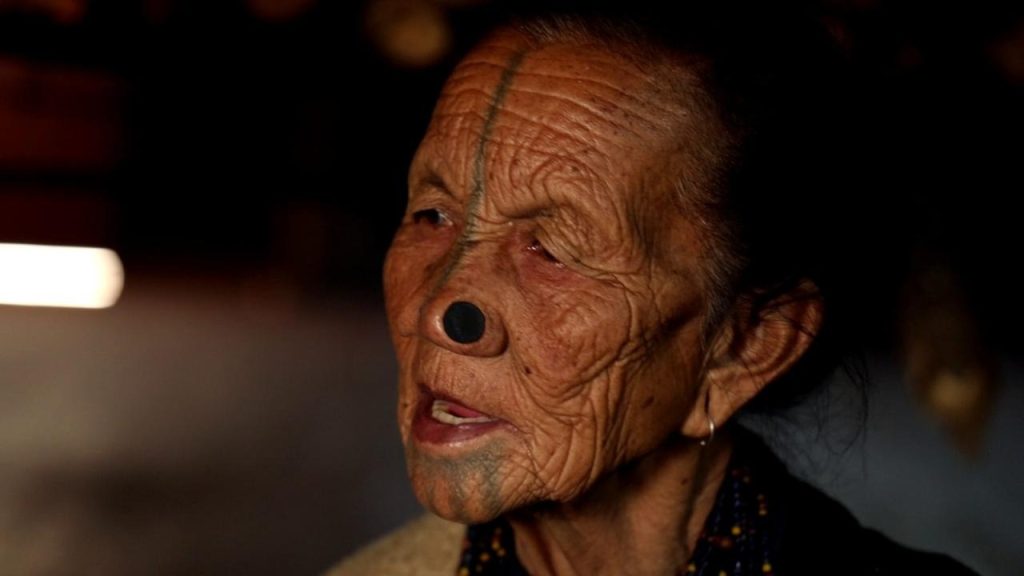
The women become, almost instantly, “the photograph” people came to take. But the more I return to Ziro, the more uncomfortable that simple frame becomes. These markings are not props for a travel memory. They are personal histories, carried on the face.
The traditional Apatani facial tattoos, often referred to as tippei, were typically made as vertical lines on the face. A long line ran from the forehead down the nose, while smaller lines marked the chin. Many women also wore wooden nose plugs, often called yaping hullo or yaping hurlo in accounts of the practice. 2 The materials and method were intimate, local, and painful. Narang Yamyang, described in reporting as the last Apatani woman to receive a facial tattoo, recalled that the tattoo was made with a thorny plant dipped in a mixture of soot and pig fat, then tapped into the skin with a cane. “It was a very painful process,” she said.3
The most widely repeated explanation is that Apatani women were considered so beautiful that neighbouring men would abduct them, and that the tattoos and nose plugs were introduced to make them appear less attractive and protect them. This story is powerful, but it should be handled with care. It belongs to oral memory, and, as with many oral histories, it is not the only layer of meaning. Over time, what may have begun as protection or “uglification” also became identity, beauty, adulthood, belonging, and womanhood within Apatani society.4 One academic study describes the practice as something that later became “a symbol of beauty,” “a celebration” of being Apatani, and a marker of strength and cultural identity.5
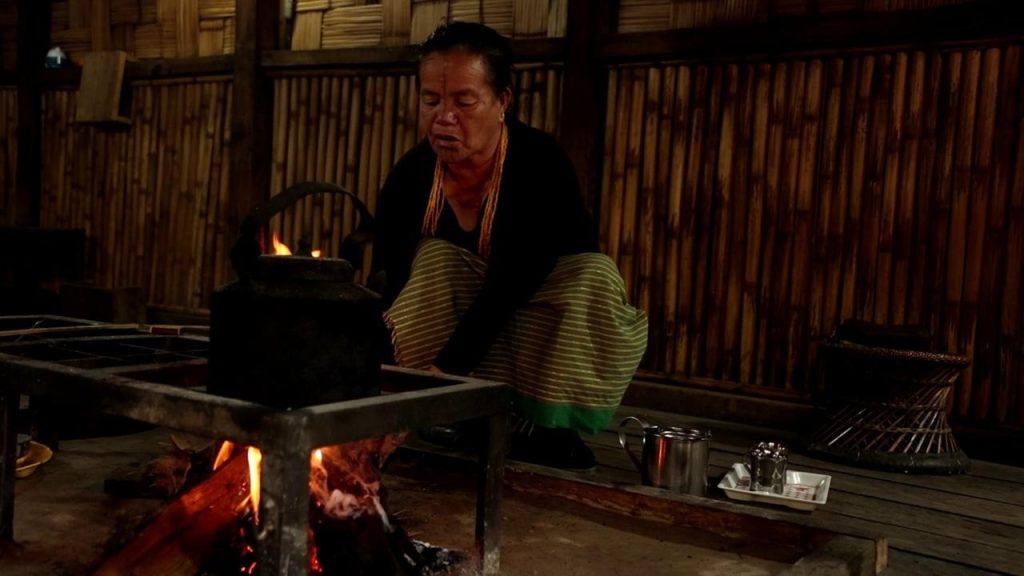
This is where the subject becomes difficult and human. Most of the women who carry these tattoos today were marked when they were very young, often around the age of ten or at the time of puberty, long before they had the kind of personal choice we now associate with body art.5 When I meet them in the villages, I usually find them shy. Many do not want to be photographed with their tattoos. Some turn away. Some smile politely but keep their distance. One or two have accepted the camera, looked directly into it, and spoken with openness. But most have not. Their hesitation has stayed with me more strongly than the photograph ever could.
What do they feel? There is no single answer, and perhaps that is the most important truth. Some older women remember the pain and the fear. Some remember the practice as part of a world where community decisions were stronger than individual preference. Some speak of it as beauty, marriageability, and honour. Narang Yamyang said there was once a belief that women with tattoos, nose plugs, and elongated earlobes found good husbands.3 Academic writing also records that some elderly tattooed women still experience the disappearance of the practice as a kind of identity loss, because what was once cultural pride has, in modern eyes, often been turned into an object of curiosity.5
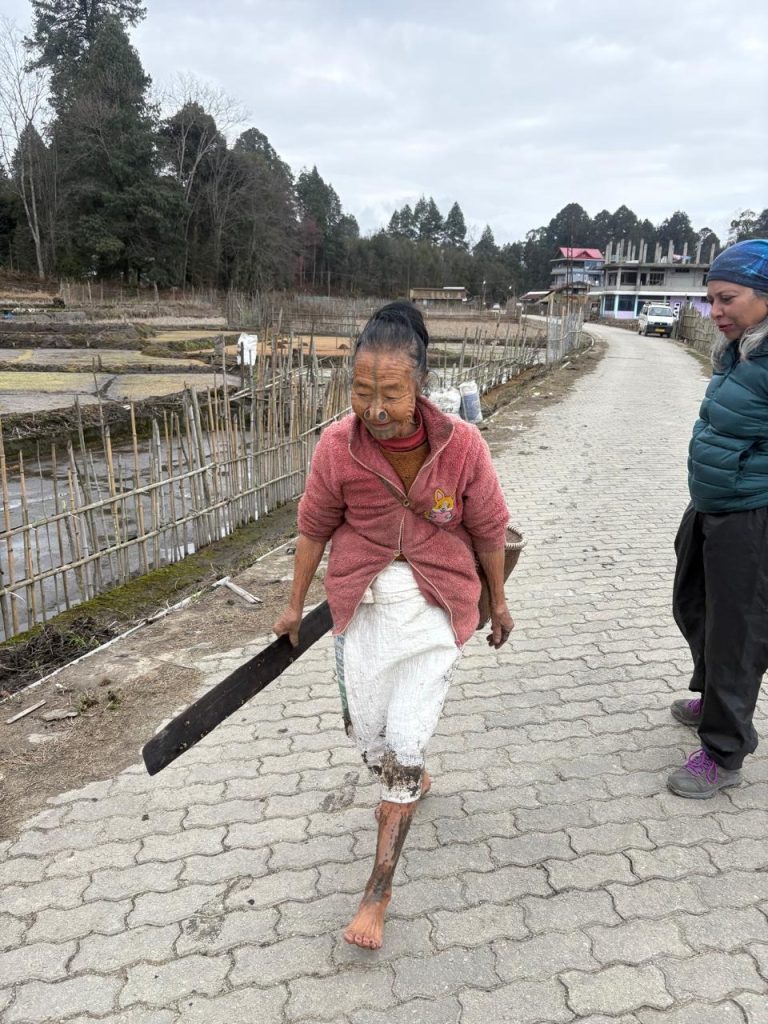
I think of one woman I met in Hong Basti. She spoke softly about the old days, about the first time she heard guns go off. It was a peace call, she explained, but it terrified everyone. Her memory placed the tattoos back into their true landscape: a valley once surrounded by inter-tribal tensions, uncertainty, and lives lived without modern facilities or amenities. It is easy, from the comfort of today, to judge the past too quickly. It is also easy to romanticise it. Neither does justice to the women who lived through it.
The practice began to disappear in the 1970s. Some accounts say it was outlawed in the 1970s as Ziro changed under the influence of education, administration, modern beauty ideals, and outside religious and social pressures.5 A 2017 report states that Apatanis used facial tattoos until 1974, when the practice was banned because tattooed people were easily identified and discriminated against. The same report credits Dr Dani Duri with taking an early step against the practice in 1974, after which younger people increasingly supported its abandonment.3 In this sense, the abolition was not only about rejecting tradition. It was also about survival in a changing world.
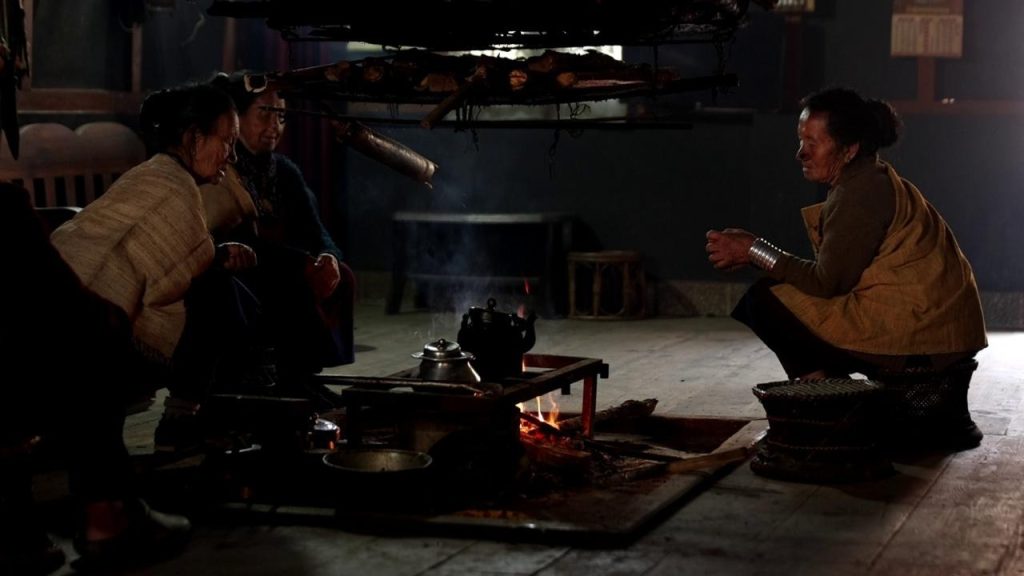
For younger Apatanis, the tattoos are not necessarily a loss they wish to restore. Many study and work outside Ziro. They wear modern clothes, take up professional jobs, travel to Indian cities, and encounter discrimination simply for looking different from the mainland majority. One young Apatani quoted in The New Indian Express asked what kind of attention face tattoos would attract in a shopping mall when people from the Northeast already face prejudice for their features.3 Another elder in the same report made a striking point: a person does not lose identity merely by giving up facial tattoos; identity is more deeply threatened when language is lost.3
That observation matters. If we make Apatani identity only about tattooed faces, we miss the living culture all around us. We miss the rice fields and fish channels. We miss Dree and Myoko. We miss the bulyañ, the traditional village council. We miss the bamboo and cane skills, the ecological intelligence, the oral histories, the shifting architecture, the young people negotiating home and modernity, and the elders who still hold memories that are not always easy to speak about.1

As travellers, we need to change the question. Instead of asking, “Can I take your photograph?” perhaps we should first ask, “May I sit?” Instead of chasing the exotic, we can notice discomfort. Instead of treating an elderly woman’s face as a rare object, we can recognise it as a life story marked without her childhood consent, later reinterpreted by history, tourism, and modernity.
The last tattooed Apatani women are often called symbols of a vanishing tradition.
But they are not symbols first. They are women first. Some are shy. Some are amused by our curiosity. Some are proud. Some are tired of being looked at. Some may carry pride and pain at the same time. When we meet them in Ziro, the responsibility is ours: to look with respect, to ask with humility, and to remember that not everything beautiful needs to be photographed.
In Ziro, the tattoos are not merely lines on a face. They are lines between past and present, between community and choice, between the traveller’s gaze and a woman’s right to be more than what we came to see.
Sources
Some images shared by Santsh Rai
Footnotes
1.UNESCO World Heritage Centre, “Apatani Cultural Landscape”, Tentative List submission by India, 2014; District Lower Subansiri, Government of Arunachal Pradesh, “Tribes”. ↩ ↩2
2.Remote Lands, Marco Ferrarese, “Ugly Beautiful: The Facial Tattoos & Nose Plugs of the Apatani People”, 2022. ↩
3.Aishik Chanda, The New Indian Express, “Arunachal’s Apatani tribe won’t get inked: Dropping traditions in fear of discrimination”, updated 2017. ↩ ↩2 ↩3 ↩4 ↩5
4.The abduction/protection explanation appears in travel writing and reporting, but it is best presented as an oral or widely repeated explanation rather than an uncontested historical fact. ↩
5.Shrestha Bharadwaj and Uttam Boruah, “Inking the Identity: A Study of the Apatani Tradition of Tattooing through Bakhtinian Chronotope,” Rupkatha Journal on Interdisciplinary Studies in Humanities, Vol. 12, No. 5, 2020, DOI: 10.21659/rupkatha.v12n5.rioc1s29n1. ↩ ↩2 ↩3 ↩4