The Reang, also known as the Bru or Riang, are one of Tripura’s Indigenous communities. The names overlap in public usage, but they do not always carry the same meaning in every context. A recent historical study notes that many community members use Bru as a self-designation, while Reang or Riang is widely used by others. The respectful practice is to follow the name preferred by the people being represented.
Their history lives in customary institutions, agricultural knowledge, oral narratives, woven motifs, dance and jewellery. Reang culture is not a museum fragment. It is a living tradition that has adapted to state policy, migration, displacement, education, urban work and new markets.

A history shaped by hills, cultivation and community law
Historical and ethnographic accounts describe the Reang as an Indigenous Tibeto-Burman-speaking community whose traditional economy was closely linked to the hills and forests of the region. Jhum, or shifting cultivation, required knowledge of soil, rainfall, forest growth and seasonal movement. It also shaped settlement patterns, work-sharing and community relationships.
Reang society maintained its own customary institutions. A 2025 study describes the Chudri as a village head and the Moyal Chudri as an area chief. These institutions dealt with marriage, childbirth, death rituals and disputes. Reang history is therefore not only a story of migration or government classification; it is also a history of community-based decision-making and social responsibility.
The origin of the name Reang is explained in a community narrative recorded by the same study. According to this oral tradition, the name became associated with a powerful ruler remembered as Reang or Riang, whose authority extended over several clans. This should be understood as oral history and collective memory rather than as an independently verified chronology. It nevertheless reveals how names, power and clan identity are remembered within the community.
Modern administration brought further changes. Tripura’s official Directorate of Tribal Research, Rehabilitation and Particularly Vulnerable Tribal Groups records that Reang families in remote hamlets became the focus of rehabilitation and development programmes from the 1980s. Plantation and land-based schemes contributed to a decline in shifting cultivation in some areas, while education, roads and healthcare expanded. Older documents may use the term “PTG”; today, the category is generally referred to as Particularly Vulnerable Tribal Group, or PVTG.
The most painful chapter in recent Reang/Bru history concerns displacement from Mizoram. In 1997, ethnic tension forced many Bru-Reang people to cross into Tripura. The Government of India recorded that refugees lived for years in camps around Kanchanpur in North Tripura. In January 2020, an agreement provided for the rehabilitation of about 34,000 displaced people in Tripura, with land, housing assistance, rations and access to government welfare schemes.
That history matters when Reang culture is discussed. Clothing, jewellery and dance cannot be separated from questions of home, land, dignity and belonging. Families carried language, ritual knowledge, craft traditions and social memory through conditions that repeatedly changed around them.

Women’s clothing: the Rignai and the language of the loom
In the wider Tiprasa cultural world, women’s traditional dress includes the rignai, a wraparound lower garment, and the risa, an upper garment. The Tripura Tribal Areas Autonomous District Council describes these clothes as being decorated with community motifs and commonly worn with silver ornaments.
Among Reang women, the rignai is often described through black-and-white combinations and striped patterns. A study of Tripuri and Reang women’s dress records one form with stripes across the body and another in which stripes are concentrated along the borders. The study associates these forms with different age groups, including younger and older women. These descriptions are not an unchanging rule for every village or family. Dress varies with age, occasion, marital status, location, personal choice and the availability of cloth.
The strength of Reang textile tradition lies in the relationship between cloth and design. Traditional weavers produced geometric motifs inspired by plants, animals and familiar objects. The 2024 costume study records Reang designs described as malim mhba, associated with the jasmine flower; wah mul, associated with the bamboo flower; and thakumtum, associated with a duck’s egg. It also mentions lakkhipati, anji, cane-leaf forms, rainbow designs and tongla khandai, connected with the shape of a cockscomb. Spellings and pronunciations may vary when Indigenous terms are written in English.
These motifs are more than surface decoration. They form a visual vocabulary through which a community identifies itself. Small sample pieces, kept as references for copying designs, helped preserve patterns across generations. The colour and placement of a motif could show the weaver’s skill, the intended use of the cloth and the cultural setting in which it would be worn.
Cotton yarn was traditionally important, but contemporary weavers may also use acrylic, rayon and polyester. The shift reflects changes in availability, price, work patterns and urban life. As more women enter education and employment, and factory-made cloth becomes easier to buy, fewer people may have time to weave an entire garment. At the same time, rignai and risa continue to be worn at ceremonies, cultural gatherings and performances.
Reang clothing should not be described simply as “traditional costume”. It can be everyday clothing, ceremonial dress, a family gift, a sign of respect or a deliberate statement of identity. Its meaning changes with the wearer and the occasion.

Jewellery in silver, beads and memory
Reang jewellery traditionally included ornaments for both women and men. A community-focused account describes silver as the preferred material, while aluminium became more common as silver grew less affordable. This difference could also reflect economic position.


Women’s ornaments were worn from the hair to the ankles. Hairpins known as Sangai appear in several forms, including Sangai Dunang, Sangai Sada and the more generally worn Sangai. The ears could carry several pieces: Naboah for the lower ear, Wareih for the upper ear and Wakhoms a hollow ear plugs usually attached to Naboah. Multiple piercings and substantial earrings gave the ear ornaments a distinctive profile.
Neck ornaments ranged from small bead necklaces to silver chokers, layered chains and coin jewellery. Ikois were made from small beads. Kanthi was a silver choker, while Chandrohas were layered chains with intricate designs. Rangbouhs and Rangbouh Sanangs used small silver coins, with the latter referring to heavier coin chains.


The hands and arms were decorated with Yaosohs, heavy wrist bracelets; Taars, worn on the upper arm; and Berberang Yaksos, spiralled and flattened silver bangles. On the legs, Bingis were silver ornaments shaped like rings and worn as anklets. These names come from a community article, and local usage may differ by family, locality or generation.
Men traditionally wore ornaments as well. The same account lists Ikai, a bead necklace; Mathia, bangles; and Bata, armlets. Men with long hair also used Sangai hairpins. In recent decades, men’s jewellery has become less common, partly because urban and mainstream settings often stigmatise men who wear ornaments. Women have retained more of these styles, although their use is also changing.
Jewellery could communicate beauty, wealth, status and belonging, but it also carried meanings connected with life-cycle customs. The community account records a practice in which a widow removed her jewellery until the funeral rites of her husband were completed. The ornaments were later returned through a ceremony called khumsuhmi. This is a documented custom, not a universal rule followed by every Reang family today.
Hojagiri and the continuity of culture
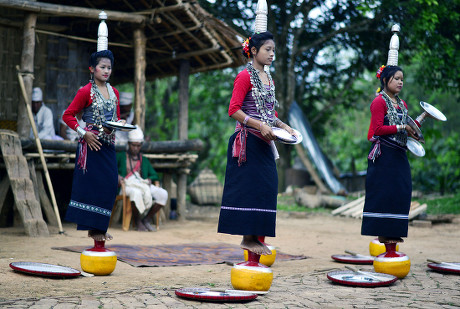
The Reang/Bru cultural world is widely associated with Hojagiri, a dance performed by young women during the Hojagiri Festival. The official account of the Tripura Tribal Areas Autonomous District Council connects the festival with worship of Lampra and prayers for a good harvest. Dancers balance earthen pots while performing controlled movements, accompanied by instruments such as the kham, siphung and sarinda.
Hojagiri is often presented to visitors as a feat of balance. It is also a community practice tied to festival, music, dress, discipline and collective memory. When dancers appear in woven garments and jewellery, the performance brings together the agricultural cycle, the work of women, traditional instruments and the visual language of the loom.
The future of Reang heritage will not depend on freezing these forms in the past. It will depend on whether younger people can continue to learn the names of motifs, the skills of weaving, the meanings of ornaments, the responsibilities of customary institutions and the stories carried by elders. New fabrics, online markets, contemporary designs and public performances may alter appearance, but they can also create new ways for the community to sustain its identity.
To understand the Reang people of Tripura is to look beyond a list of garments and ornaments. The rignai is a woven record of place and identity. A silver necklace can carry memory, status and social meaning. A dance can preserve a relationship with harvest and devotion. Together, they show how a community’s history remains visible—not as a relic, but as a practice continually renewed.
Image courtesy – Shalini Shiv Prasad of Orka.photography
References
[1] Susmita Banerjee and Lincoln Reang, “Traditional Self-Governing Institution: A Historical Case Study on the Customary Law and Practices of the Reang Community of Tripura”, RGU Journal of Social Science and Research, 2025. DOI: https://doi.org/10.3254/rgujssr.v1i3.74
[2] Susmita Banerjee and Lincoln Reang, “Traditional Self-Governing Institution: A Historical Case Study on the Customary Law and Practices of the Reang Community of Tripura”, RGU Journal of Social Science and Research, 2025. DOI: https://doi.org/10.3254/rgujssr.v1i3.74
[3] Banerjee and Reang, “Traditional Self-Governing Institution”, 2025, DOI: https://doi.org/10.3254/rgujssr.v1i3.74.
[4] Banerjee and Reang, “Traditional Self-Governing Institution”, 2025. The account of the name’s origin is identified in the study as an oral or community narrative.
[5] Government of Tripura, “Institutional Framework for Welfare of Tribes in Tripura”, https://twd.tripura.gov.in/institutional-framework-welfare-tribes-tripura; Directorate of TRP & PVTG, Government of Tripura, https://ptg.tripura.gov.in/
[6] Press Information Bureau, “Prime Minister Says Bru–Reang Agreement provides succour and relief to over 35,000 refugees”, 26 January 2020, https://www.pib.gov.in/PressReleaseIframePage.aspx?PRID=1600612
[7] Tripura Tribal Areas Autonomous District Council, “Cultural and Dance Traditions of the Tiprasa People”, https://ttaadc.gov.in/cultural
[8] Gitanjali Roy, “Mapping Tradition and Modernization: A Study on the Evolution of the Costumes of the Tripuri and Reang Women in Tripura”, ShodhKosh: Journal of Visual and Performing Arts, 2024. DOI: https://doi.org/10.29121/shodhkosh.v5.i1.2024.631
[9] Roy, “Mapping Tradition and Modernization”, 2024, DOI: https://doi.org/10.29121/shodhkosh.v5.i1.2024.631.
[10] Roy, “Mapping Tradition and Modernization”, 2024, DOI: https://doi.org/10.29121/shodhkosh.v5.i1.2024.631.
[11] Anuprava Debbarma, “The Traditional Ornaments Of The Reang Tribe Of Tripura”, Adivasi Lives Matter, 2 November 2022, https://www.adivasilivesmatter.com/post/the-traditional-ornaments-of-the-reang-tribe-of-tripura
[12] Debbarma, “The Traditional Ornaments Of The Reang Tribe Of Tripura”, 2022.
[13] Debbarma, “The Traditional Ornaments Of The Reang Tribe Of Tripura”, 2022. The article records this as a documented custom; practices may vary among families and localities.
[14] Tripura Tribal Areas Autonomous District Council, “Cultural and Dance Traditions of the Tiprasa People”, https://ttaadc.gov.in/cultural