
Stories of gibbons, tea gardens, Tangsa culture, rivers and Namdapha
The Morning the Forest Came to Visit
My children were so excited – ages 7 and 8 that they were awake before dawn for the day to begin.
In the soft, pale light of an Upper Assam morning, we leave the tea-garden bungalow quietly, carrying flasks of tea, warm clothes and egg sandwiches for the road. Somewhere beyond the houses, a bird calls once, then again. The children were asleep in the backseat when they arrived at Barekuri, a village near Tinsukia where people have lived alongside hoolock gibbons for generations.
The village is beginning its day. Someone is sweeping a courtyard. Smoke rises from the kitchen. A bicycle passes slowly along the road. Then a movement in the trees catches all our attention.
A dark shape swings between branches. Another appears behind it. The gibbons move with astonishing ease, their long arms carrying them from tree to tree as though the forest were a series of bridges built specially for them. The children stopped talking. Even the adults fall silent.
The family watches from the ground while the village continues around them. This is not a performance arranged for visitors. It is an old relationship between people and animals, renewed each morning in the ordinary rhythm of village life. The children see that wildlife is not always found behind a fence or on a safari. Sometimes it lives above a roof, crosses a lane and looks down from a tree beside someone’s home.
Later, over breakfast, the children try to imitate the gibbons’ swinging arms. We all laugh and discuss what is a primate and the features that distinguish the Hoolock Gibbons. The use of both hands and feet to grasp the tree branches, also as if they were walking through the trees, their forward-facing eyes, their social adaptation and advanced brain much to the amusement of the kids who tried to imitate the gibbon calls.
The tea garden changes the pace of the journey
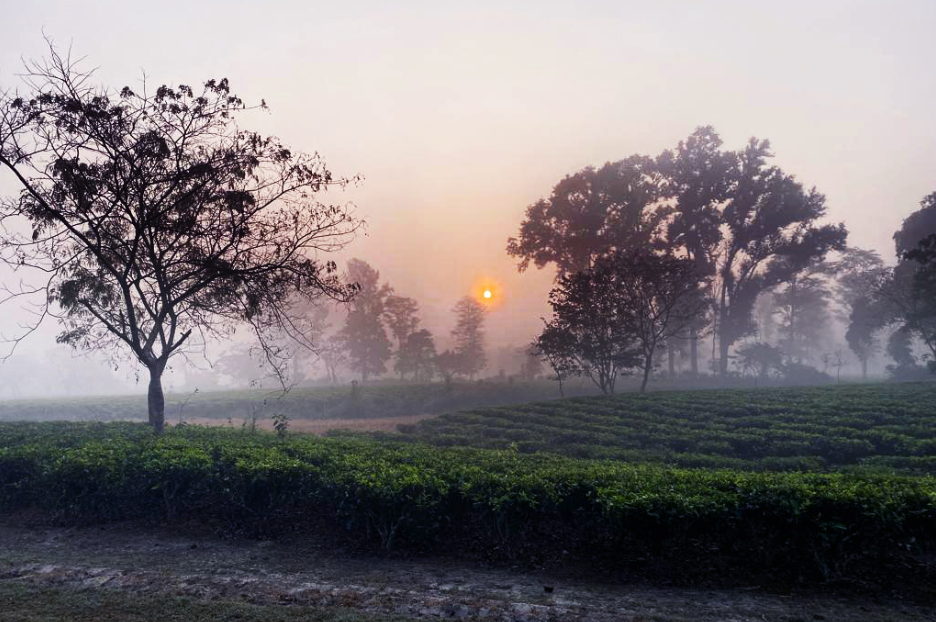
There is space everywhere: long green rows disappearing towards the horizon, tall shade trees rising above the bushes, and wide lawns where the children immediately start a game that requires a lot of running and rolling on the grass. One child chases after a butterfly while the other collects fallen leaves while I sit beneath a tree with a cup of fresh Assam tea, known as Lal Sa.
A tea garden is especially beautiful when it is experienced slowly. A tea worker shows the children the familiar phrase: two leaves and a bud. Soon the children are bending over the bushes, trying to pluck the tender shoots with serious concentration. While I watch the tea plucker’s move quickly and deftly among the bushes. Kids want to know if they can make tea from their pickings, every leaf becomes important because it has been picked by their own hands.
The tea garden staff explain how the leaves travel from the field to the factory. The children watch the baskets being weighed and listen to the sounds of machinery. Later, they too drink a cup of Lal sa with sugar in it with pride as if they are a part of the work force.
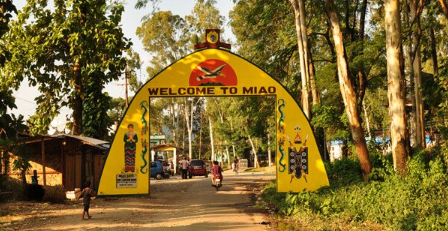
The Road Towards Miao
As the road moves towards eastern Arunachal Pradesh, the landscape grows more intimate. The broad openness of the plains gives way to forested slopes, streams and deep shades of green. We cross into a world where the journey itself becomes part of the experience.
Miao feels like a meeting place. It is a gateway to Namdapha National Park, a town shaped by forests, rivers and many communities. Here, we begin to understand that the region’s richness lies not only in its scenery, but among the people who have made their homes around these forests.
A local Tangsa host tells the children about the community’s traditions, clothing, food and connection with the land. The children are drawn first to the colours and textures: woven patterns, ornaments, baskets and fabrics. We try on the traditional belt, carry the sword and wear the beaded necklaces much to the thrill of the local children who have gathered in large numbers to witness the moment.
My children begin to notice the stories around them, the bamboo handmade chicken scoop, the sarong wrap the other children are wearing, the way the babies are carried in fabric pouches by the older kids. The Tangsa world is introduced not as a museum display, but through conversation, food and the generosity of a family welcoming visitors into its everyday life.
The children learn a few local words. They taste something unfamiliar and decide that they like it. One of them tries a traditional rhythm with a spoon against a table. I listen as the conversation moves between English, Hindi and local languages.
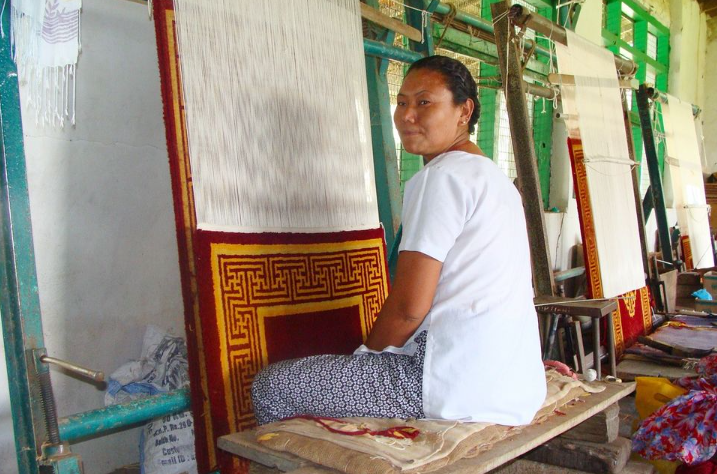
The Carpet That Took Months to Make
A short distance from Miao, we visit the Tibetan settlement at Choephelling, known for its handmade carpets.
The carpet centre is a place where children can see patience made visible. A weaver sits before a loom, her hands moving with an assured rhythm. Threads pass through the frame, row after row, creating patterns that seem almost impossible to build one small movement at a time.
The children first look at the finished carpets. They point to the animals, flowers and geometric shapes. Then they watch the weaver work and understand that the beauty comes from repetition. A carpet is not produced in a single moment. It grows slowly through skill, concentration and memory. One weaver allows a child to pass the thread through on her loom.
We hear about the settlement’s history and the continuation of Tibetan craft in Miao. The children are given the chance to look closely at the wool and the tools. They begin to appreciate something made carefully.
Before leaving, I let the kids choose a small woven piece to take home. It becomes more than a souvenir. It carries the memory of the room, the sound of the loom and the quiet dignity of the person who made it.
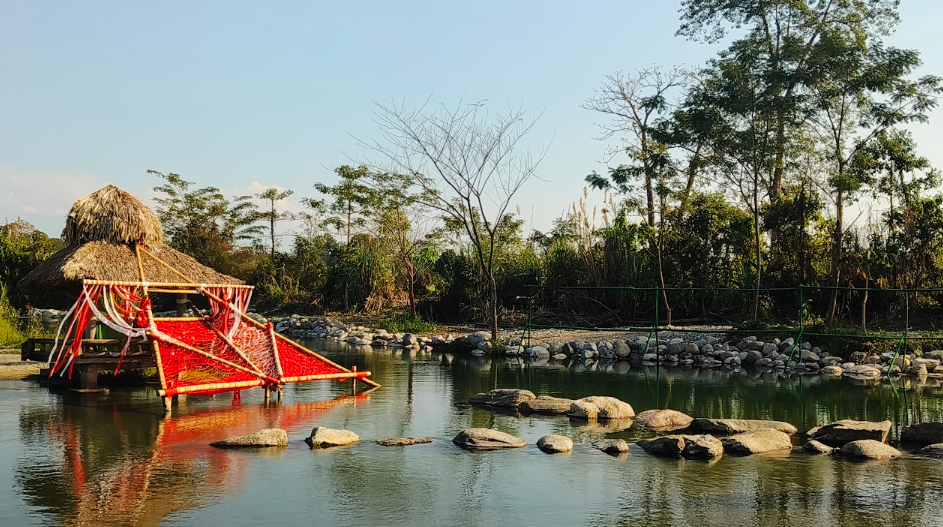
A Picnic Beside the Miao River
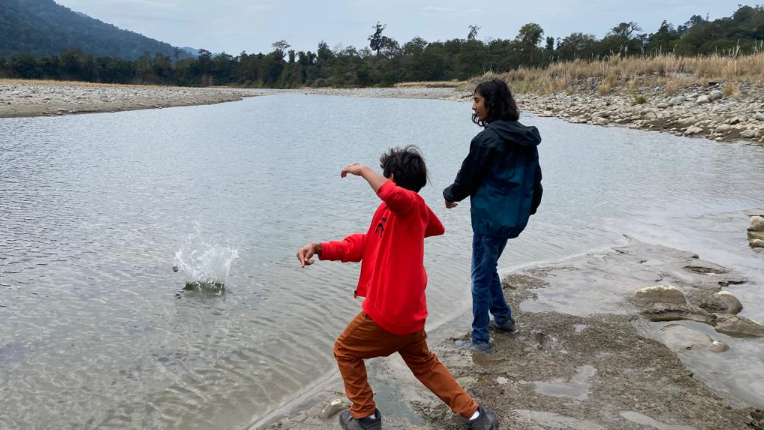
By afternoon, we follow the road towards the Miao River, associated with the Dehing landscape. The water moves over stones, clear in some places and dark in others where the forest reflects on its surface. The children remove their shoes and sit at the edge, letting the current run around their feet.
Lunch is simple: rice, vegetables, local preparations, fruit and tea packed from the morning. The river provides the entertainment. A smooth stone becomes a paperweight. A fallen branch becomes a bridge in an imaginary forest. The children look for tiny fish and watch leaves travelling downstream.
The adults sit together under the trees while the children explore within sight. The river makes everyone slow down. There is no need for a timetable, a queue or a loud attraction. The sound of water fills the spaces between conversations.
At one point, we all become quiet. Across the river, the forest rises in layers. The children are tired from the morning and lean against me and doze off to the sound of the river flowing by. The picnic became one of those travel memories that remains vivid because it was so ordinary: food shared outdoors, wet feet, laughter and the feeling of having found a beautiful place before the crowd arrived.
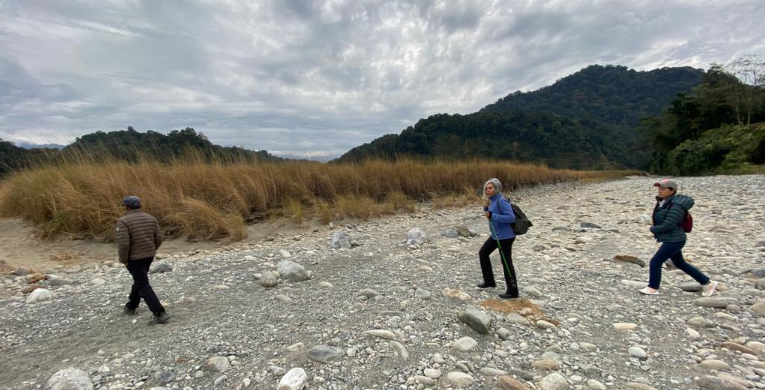
Into the Forest of Namdapha
It is a vast forest where rivers, hills and trees create a habitat for an extraordinary range of wildlife. We travel with a local guide who understands the landscape and knows that the forest reveals itself gradually. A bird calls from somewhere unseen. A branch trembles. Leeches, insects, butterflies and birds become part of the children’s private catalogue of discoveries.
The guide tells them that a forest is not only made of the large animals people hope to see. It is also made of fungi on fallen wood, ants carrying leaves, orchids growing high above the ground and small streams feeding larger rivers. The children begin to look down as carefully as they look up.
We adults understand that Namdapha is not a place to measure by the number of animals seen. Its gift is the experience of entering a living world that does not revolve around visitors. We walk quietly, listen carefully and learn that patience is itself a form of adventure.
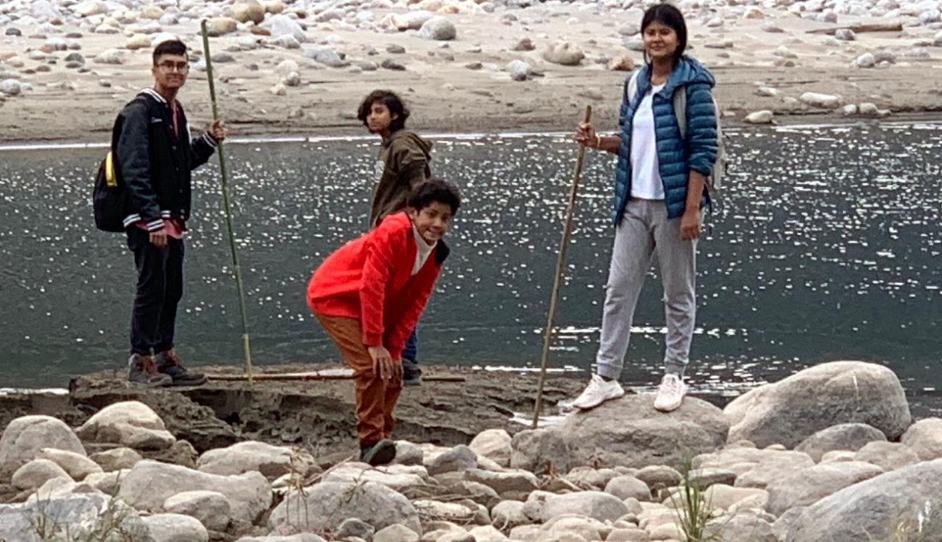
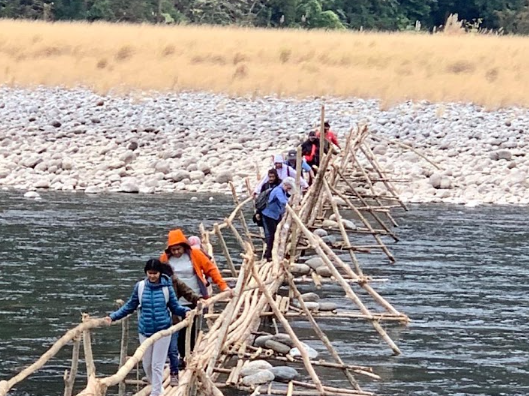
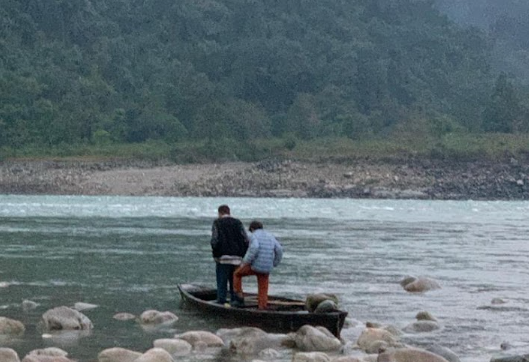
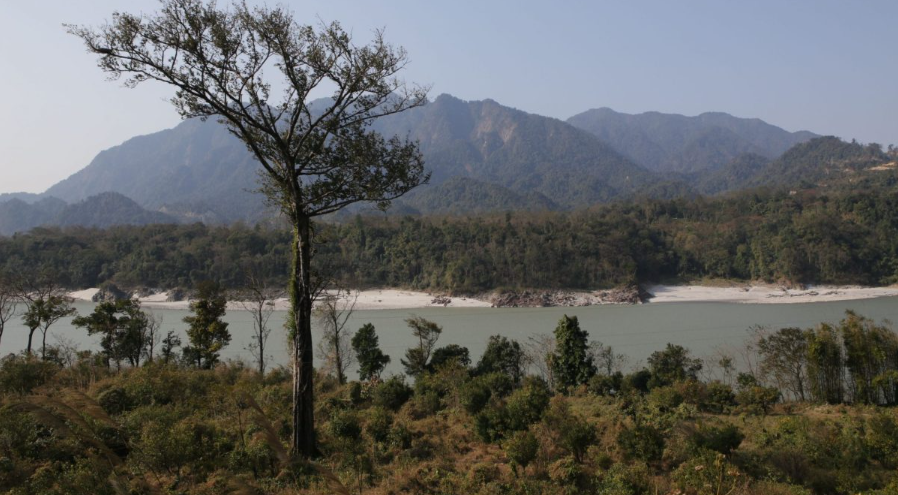
For the children, the forest becomes a story with invisible characters. A rustle may be a bird. A footprint may belong to an animal that passed hours earlier. The absence of a dramatic sighting does not make the forest empty. It makes the children more observant. The thrill of crossing the bamboo bridge at the beginning and end of our forest walk was a highlight for all. The dramatic beautiful views of the east Himalayas and the wide beautiful river made it a favorite place for us all.
The Journey They Carry Home
The morning village where hoolock gibbons move through the trees above ordinary household life. There is the tea garden where small hands learned to pick two leaves and a bud. Tangsa welcome, filled with colour, food and conversation. The carpet taking shape beneath a weaver’s patient hands. The Dehing riverbank where lunch became a picnic and stones became toys. Tall mountains near Namdapha, vast and watchful, teaching us how to listen. So many precious moments, so many new connections with my children.
The children may remember the gibbons most vividly. They may remember running through the tea garden, or standing beside the river with their trousers rolled up. The kindness of local hosts and the feeling of seeing a part of India where forest, culture and daily life remain closely connected I think are not lost on the children.
That is what makes this journey special as a family. It is not a collection of sightseeing stops. It is a chain of living stories: a village that shares its trees with apes, a garden that turns leaves into tea, a community that keeps its traditions alive, a river that gathers everyone around it and a forest that invites visitors to become more attentive.
In Assam and East Arunachal Pradesh, the most memorable moments often arrive gently. A gibbon swings into view. A child picks the perfect tea leaf. A weaver turns a thread. A river carries a leaf away.
Practical Notes for Making the Journey Comfortable
Best months to visit
For a family with small children, the most comfortable months are November to April. The weather is generally drier, the roads are easier, and mornings in the tea gardens and forest are pleasant. November to February is especially good for long outdoor days, village visits and wildlife experiences. Children can play outside without the intense heat and humidity of the pre-monsoon months.
If tea plucking is an important part of the experience, consider April or early May. Tea estates are active during this period, and a garden may be able to arrange a supervised plucking session. These months can be warmer, however, and occasional showers are possible. Tea plucking is seasonal and depends on the estate, so it should be arranged before arrival rather than assumed.
The monsoon months, particularly June to September, bring heavy rain to Assam and Arunachal Pradesh. Rivers can rise quickly, forest roads can become difficult, and landslides or road repairs can affect access to Namdapha and Miao. Kaziranga also operates under seasonal conditions, so its safari and entry arrangements must be checked separately. If you are considering travelling in September 2026, speak with a local operator about current road, river and park conditions before confirming the trip.
Travel slowly by private car
This journey works best as a slow private-car holiday, with an experienced local driver who knows the roads beyond Assam. A private vehicle allows the family to stop when the children are tired, pause beside a tea garden or river and change plans when the weather turns. Avoid night driving, particularly on forest and hill roads.
Arrange Arunachal permits
Arunachal Pradesh requires an Inner Line Permit for Indian visitors. Every member of the family, including children, should be included in the application. The official Tourist eILP portal states that the tourist permit is available for stays of up to 14 days. Carry printed copies as well as digital copies, along with identification documents. Foreign visitors have different permit requirements and should confirm the current rules before planning the Arunachal portion.
Plan Namdapha with a local guide
Arrange Namdapha access, forest permissions and a local guide in advance. Namdapha is a real forest rather than a conventional sightseeing park. Trails, accommodation, vehicle access and guide availability can change with weather and local conditions. A guide can also interpret the calls, tracks and plants that children might otherwise miss.
Treat the gibbon visit as a wildlife encounter
The early-morning visit to Barekuri, the village known for its long relationship with hoolock gibbons, should be treated as a wildlife encounter rather than a guaranteed show. Gibbons may be seen in the village trees, but they are wild animals and may remain hidden. A local community guide is the best person to identify recent activity and to explain how visitors should behave. Keep your distance, avoid loud calls and never offer food.
Meet the Tangsa community respectfully
For the Tangsa cultural experience, arrange a visit through a local host rather than arriving with the expectation of a staged performance. A family meal, a conversation about farming and weaving, or a chance to learn about traditional clothing can be more meaningful than a formal programme. Ask permission before photographing people, homes, religious objects or children. The name is commonly written Tangsa, although visitors sometimes write “Tanga.”
Allow time at Choephelling
At the Tibetan settlement near Miao, allow time to watch the carpet-making process rather than simply buying a finished piece. The children can see how a pattern is built gradually, thread by thread. Ask whether the weaving centre is open on the day of the visit and whether demonstrations or purchases support the local cooperative.
Be careful beside the river
A picnic beside the Miao or Dehing river landscape should be planned with care. The riverbank may look calm while the current is strong, especially after rain. Choose a spot recommended by a local host, keep children within arm’s reach near the water and do not allow swimming or climbing on slippery rocks. Carry food back out, avoid disposable plastic and leave the riverbank as it was found.
Make tea plucking child-friendly
Ask the estate whether children may enter the plucking area, whether a guide will accompany them and whether the garden can provide a safe open space for play. Wear closed shoes, light long sleeves and hats. Children should not wander into tea-factory machinery areas or approach workers while they are carrying heavy baskets.
Pack for changing conditions
Pack light rain jackets, quick-drying clothes, sandals that can get wet, sturdy shoes, insect repellent, sunscreen, hats, personal medicines and motion-sickness medication. A small first-aid kit is sensible, as is a supply of familiar snacks for long drives. Roads can be winding, so regular breaks are more useful than trying to reach every stop quickly.
Keep a flexible day
Mobile connectivity may be inconsistent around Miao and Namdapha. Keep important telephone numbers, permits, hotel details and driver information offline. Carry some cash because smaller settlements and local craft centres may not accept cards. It is also sensible to keep one flexible day in the overall holiday, since rain, road conditions or a tired child can change the rhythm of the journey.
Useful Official and Background Sources
Arunachal Pradesh Tourist eILP portal: https://www.eilp.arunachal.gov.in/preTuristEIlpKYC
Changlang District Administration: Places of Interest: https://changlang.nic.in/places-of-interest/
The Hindu: “Hoolock gibbons feel quite at home in this Assam village”: https://www.thehindu.com/sci-tech/energy-and-environment/hoolock-gibbons-feel-quite-at-home-in-this-assam-village/article24993870.ece